

Lost Voices: Marty Springstead
The longtime American League umpire had me laughing when I asked him about arguing with Earl Weaver during a 1999 interview for my book on Orioles history.

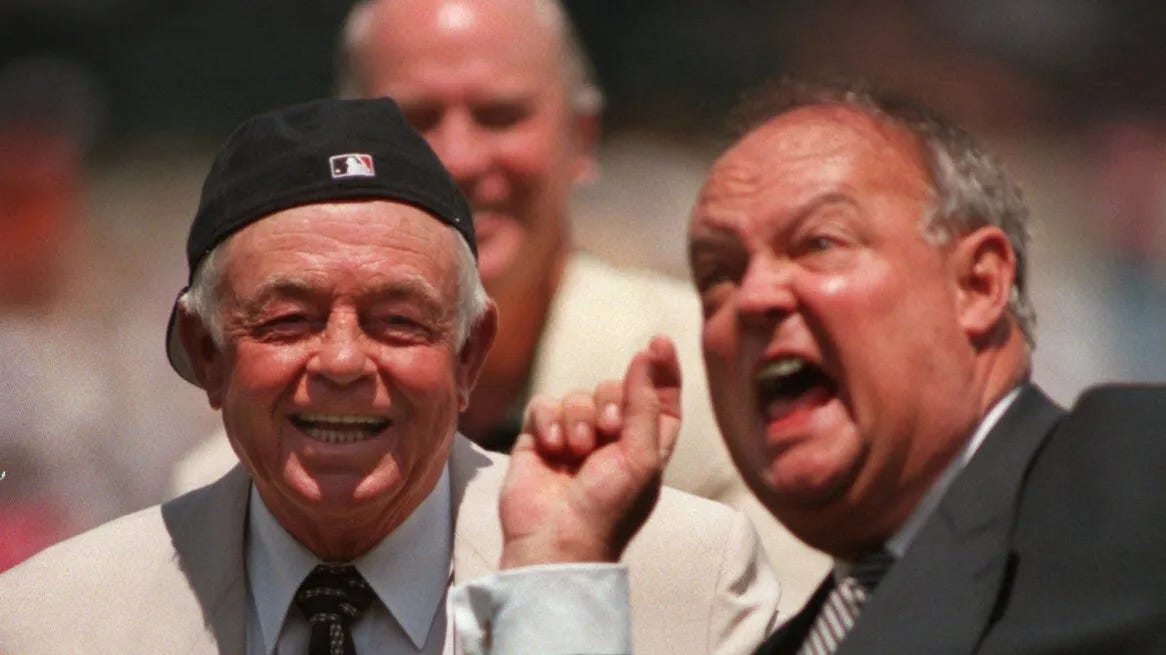
(One in a series of articles highlighting former baseball figures whom I interviewed for my oral history of the Orioles more than a quarter-century ago, but only on the phone, depriving me of a recording I could play now as a Bird Tapes interview.)
When I wrote From 33rd Street to Camden Yards, my oral history of the Orioles, a quarter-century ago, my first commandment was journalistic balance.
After Steve Barber repeatedly ripped former teammate Milt Pappas in his interview for the book, it became imperative that I also interview Pappas and give him a chance to tell his side of various controversies.
When several of Earl Weaver’s former players, most notably Ken Singleton and Rick Dempsey, complained that Weaver’s profane antics sometimes got in the way of them doing their jobs, I had to get Weaver’s thoughts on that.
After Weaver explained why umpires upset him so much that he couldn't help arguing with them, I felt compelled to get the other side of that story. That led me to Marty Springstead, a prominent American League umpire who battled ferociously with Weaver during his two decades (1966-1985) behind the plate.
Among the nearly 100 interview subjects whose recollections formed the text of the book, Springstead was the only one who never drew a paycheck from the Orioles. But he was a delightful addition to the project.
When he died at age 74 in 2012, his New York Times obituary described him as “witty” and “voluble.” I could attest to that. In 1999, when I reached him by phone and told him I wanted to talk about Weaver, he just laughed and launched into a memorable diatribe.
“He was just a pain in the ass, yelling from the dugout, screaming when he didn’t get a pitch, all kinds of shit … in between (cigarette) puffs,” Springsteen recalled. “I don’t know how many times I threw him out (of games). He says 11. I say 13. I said to him one day (during an argument) on the field, ‘You know, I could throw you out.’ He said, ‘You’ve already proved that.’ I said, ‘It’s not even fun anymore.’
“Back then, if Earl and I went to church together, we’d have been in a fight by the end of the service. We’d have found something to fight about. Either my hymn book was bigger than his, or his hymn book was bigger than mine. Something like that. We’d be at each other’s throats. That’s just the way it was. He wanted everything his way and you don’t always get that, and sometimes he just wouldn’t listen to reason. That’s where we had most of our problems. Either he didn’t want to hear your side or he didn’t believe it. He’d come out there with his cap turned sideways and he knew how to turn it so he could pop you in the nose with it.
“Here’s typical Earl. We were in the (Seattle) Kingdome and I wasn’t having a good day. We have those days, contrary to what people believe. We were in the fifth inning. Chuck Cottier was managing Seattle. In between innings, here comes Earl with his hat half-crooked. I go, ‘Oh, shit, what do you want?’ He goes, ‘I want to tell you something.’ I said, ‘What do you want to tell me, Earl?’ He says, ‘You’re having a horseshit game.’ I thought about it and said, ‘You know, Earl, you think I’m doing any better for that guy over there (pointing to Cottier)?’ He just scratched his head and walked away. That was near the end of his career. I wish I’d thought of it earlier.”
The son of a nurse and a New York City police officer, Springstead began umpiring in the minor leagues in 1960 and made it to the majors six years later. He worked four league championship series and three World Series before he retired to become executive director of umpiring for the American League.
Weaver already had a reputation for volatility, honed in the minors, when the Orioles made him their manager in 1968. But according to Springstead, his players weren’t initially the targets of his pointed criticism.
“Brooks and those guys didn’t even listen to him. He never bothered those guys. They just looked at him and ignored him,” Springstead said. “Thank God he had players like that, veteran guys like McNally. They’d have been lunatics otherwise, trying to put up with his shit. Boog (Powell) said to me one time, ‘Marty, just leave the guy alone.’ I think he was tougher on the players later on.”
In the end, Weaver became a legendary baiter of umpires and was ejected from nearly 100 games — one of the highest totals in history. There’s a debate about whether Springstead, Ron Luciano or Tom Haller ejected him the most, but there’s no doubt Springstead was on the other side of Weaver’s most infamous dispute, which ended with the Orioles forfeiting a game in Toronto in 1977.
“He was in a pennant race and the pitcher for Toronto was shutting him down. I’m the crew chief. I’m working third base,” Springstead recalled. “So it starts raining, really raining, and we had to get this game in. We’re in the bottom of the fifth, the game is already legal. All of a sudden the (Oriole) left fielder goes over and slips on a tarp in the bullpen. There were two mounds with tarps. Earl comes running out and starts a tirade about taking the tarps off. I said, ‘I’m not taking the tarps off, what if they have to warm someone up?’ I agreed to take one off. I don’t know why, but he didn’t like that either, so I said, ‘The hell with you, I’m not taking anything off, no tarps coming off.’ He said, ‘OK, we ain’t going to play.’ I said, ‘What do you mean?’ He said, “We ain’t gonna play.’ So he took his team into the clubhouse. I get (Orioles pitching coach George) Bamberger and I say, ‘Bammy, what’s he doing? Protest the game, do something, but don’t just walk off.’ Bammy says, ‘I’ll go try to talk him out of it.’ He comes back out and says, ‘They ain’t coming out.’ After 15 minutes, the rain was getting worse and I said the hell with it. I forfeited it. That put the world in shock. It was my only forfeit in 26 years of umpiring.”
Incredibly, after all those years of arguing, Weaver and Springstead became friendly after both were out of baseball.
“We get along good now,” Springstead said in 1999. “After he got out, when they gave him a day in Baltimore before he went to the Hall of Fame, no one knows this, but I drove the car around the park when he went around waving to the crowd from the back. They invited me to the ceremony and somehow I wound up driving the car, and I had this thought about halfway through: I ought to slam on the brakes and send him sprawling over the back. Smack his little ass in the dirt back there. Then I’d turn around and say, ‘Earl you got that coming. I owe you that.’ But it was his day and I didn’t do it. I thought about it the rest of the way around the field, sat up front listening to the people cheering and thought, ‘I ought to slam on these brakes and send that little bastard flying.’”